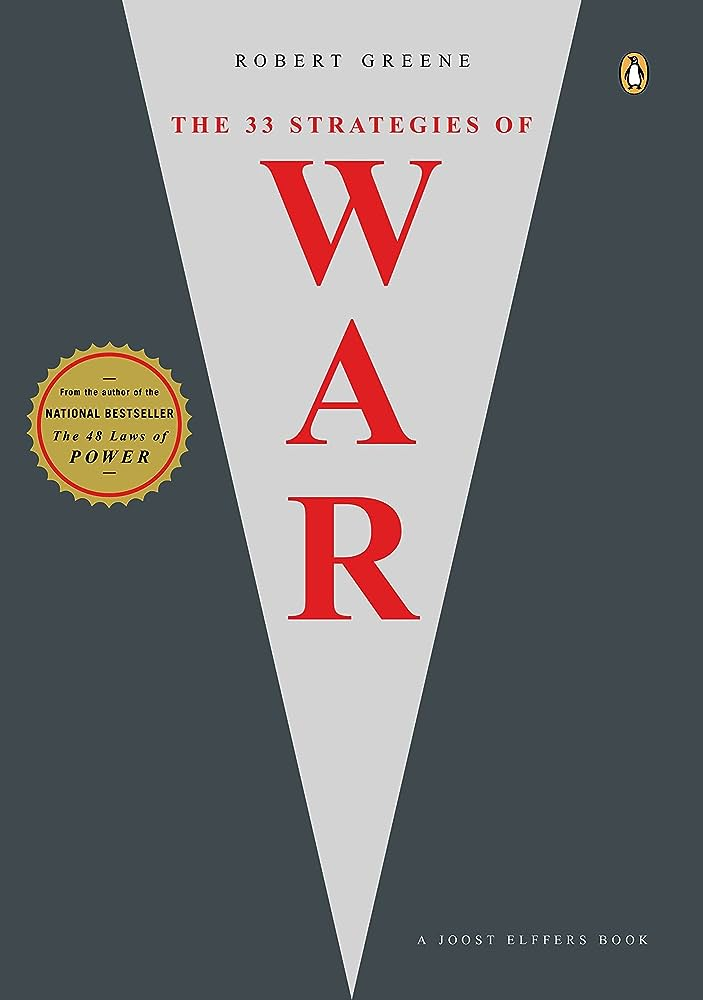
Quotes From 33 Strategies Of War

Look at things as they are not as your emotions colour them.
When you have success be extra wary.When you are angry take no action.When you are fearful know you are going to exaggerate the dangers you face
Judge people by their actions.
Depend on your own arms.
Being unconquerable lies with yourself.
Face your fears with constant practice and you will be there.
Strategy is practical knowledge of the highest form.
Events in life mean nothing if you do not reflect on them in a deep way and ideas from books are pointless if they have no application to life as you live it.
A man that is easily over whelmed by emotion, that is rooted in the past instead of the present,that cannot see the world with clarity and urgency,will create strategies that will always miss the mark.
To become a true strategist you must take 3 steps. First become aware of the weakness and illness that can take hold of the mind warping it's strategic powers. Second declare a kind of war on yourself to make yourself move forward.Third wage a ruthless and continual battle on the enemies within you by applying certain strategies.
"You know , l am sure that not numbers or strength brings victory in war but whichever army goes into battle stronger in soul, their enemies generally cannot withstand them."
Your obstacles are not rivers or mountains or people, your obstacle is yourself.
The more clearly you recognise who you do not want to be ,then the clearer your sense of identity and purpose will be.
Once you feel clear and motivated you will have space for true friendship and true compromise.
Getting along with other people is an important skill to have but it comes with a danger, by always seeking the path of least resistance, the path of conciliation, you forget who you are and you sink into the center with everyone else. Instead see yourself as an outsider surrounded by enemies. " Constant battle will keep you strong and alert".
Do not be lured by the need to be liked: better to be respected, even feared
Don't depend on the enemy not coming: depend rather on being ready for him.
The best way to get people to reveal themselves is to provoke tension and argument.
If you count on safety and do not think of danger, if you do not know enough to be wary when enemies arrive, this is called a sparrow nesting on a tent, a fish in a cauldron they won't last the day.
What most often weighs you down and brings you misery is the past, in the form of unnecessary attachments, repetitions of tired formulas and the memory of old victories and defeats.You must consciously wage war against the past and force yourself to react to the present moment. Be ruthless on yourself do not repeat the same tired methods.
Sometimes you must force yourself to strike out in new directions even if they involve risk What you may lose in comfort and security, you will gain in surprise, making it harder for your enemies to tell what you will do.
It is not always necessary to confine ourselves to the same tactics.But on the contrary, if we are adaptable to circumstances we can better escape danger.
Never take it for granted that your past success will continue into the future. Actually your past successes are your biggest obstacle:every battle, every war is different and you cannot assume that what worked before will work today.
24 Anyone can plan a campaign but few are capable of waging war because only a true military genius can handle the developments and circumstances.
Victory against superior numbers depended on suprise.
It can be valuable to analyse what went wrong in the past but it is far more important to develop the capacity to think in the moment.In that way you will make far fewer mistakes to analyse.
Attention to the details of the present is by far the best way to crowd out the past and forget the last war.
You may think that what you'd like to recapture from your youth is your looks, your physical fitness, your simple pleasures but what you really need is the fluidity of mind you once possessed.
Do not waste time on things you cannot change or influence. Just keep moving.
By constantly adapting and changing your style, you will avoid the pitfalls of your previous wars. Just when people feel they know you , you change
More life may trickle out of men through thought than through a gaping wound.
In moments of turmoil and trouble, you must force yourself to be more determined. Call up the aggressive energy you need to overcome caution and inertia. Any mistakes you make you can rectify with more energetic action. Save your carefulnes for the hours of preparation but once the fighting begins, empty your mind of doubts.
Find joy in attack mode momentum will cary you through.
Understand presence of mind is the ability to detach yourself from all that, to see the whole battle field, the whole picture and what gives you that mental distance is preparation, mastering the details before hand.
For the love of God, pull yourself together and do not look at things so darkly:the first step backward makes a poor impression in the army the second step is dangerous and the third becomes fatal.
When matters are done leisurely, seven out of ten will turn out badly.
We tend to overestimate other people's abilities after all they're trying hard to make it look as if they knew what they were doing and tend to underestimate our own. You must compensate for this by trusting yourself more and others less. It is important to remember though that being self reliant does not mean burdening yourself with petty details. You must be able to distinguish between small matters that are best left to others and larger issues that require your attention and care.
Self calmness is a must in times of fear, worry and uncertainty.
Being timid prevents us from examining and exploiting our lot as men.
Meditation on inevitable death should be performed daily. Everyday when one's body and mind are at peace one should meditate upon being ripped apart by arrows, rifles, spears and swords, being carried away by surging waves being thrown into the midst of a great fire being, struck by lightning, being shaken to death by a great earthquake, falling from thousand foot clifs, dying of a disease or commiting seppuku at the death of one's master. And every day without fail one should consider himself as dead.
A sense of urgency comes from a powerful connection to the present.
Get rid of your safety net. Sometimes you have to become a little desperate to get anywhere.
The way of the samurai is in desperateness. Ten or more cannot kill such a man. Common sense will not accomplish great things. Simply become insane and desperate.
Try to get as much as possible done in the shortest time.
Society is organised to make death invisible, to keep it several steps removed. That distance may seem necessary for our comfort but it comes with a terrible price.The illusion of limitless time and a consequent lack of seriousness about daily life. We are running away from the one reality that faces us all.
The world is ruled by necessity.
Stake everything on a single throw. Often we try too many things at one time thinking that one of then will bring us success but in these situations our minds are diffused, our efforts half hearted. It is better to take on one daunting challenge, even one that others think foolish. Our future is at stake, we cannot afford to lose, so we don't.
Death is nothing but to live defeated is to die everyday.
If you give yourself no way out you will have to make your new endeavour work.
When we are tired it's often because we are bored.
Lack of energy comes from a lack of challenges.
Sometimes death only comes from lack of energy.
Life has more meaning in the face of death.You will survive if you fight quickly and perish if you don't.
While you are sharpening your fighing spirit always do what you can to blunt your enemie's.
In war it is not men but the man that counts.
Everything starts from the top. What determines your success or failure is your style of leadership and your chain of command.
For what the leaders are that as a rule will the men below them be.
Today's world is complex and chaotic. It is harder than ever to exercise control through a chain of command. You cannot supervise everything yourself, you cannot keep your eye on everyone. Being seen as a dictator will do you harm but if you submit to complexity and let go of the chain of command, chaos will consume you. The solution is to operate through a kind of remote control. Hire deputies who share your vision but can think on their own, acting as you would in their place. Instead of wasting time negotiating with every difficult person, work on spreading a spirit of camaraderie and efficiency that becomes self policing. Streamline the organisation cutting out waste in staff in the irrelevant reports on your desk, in pointless meetings. The less attention you spend on petty details, the more time you will have for the larger picture for asserting your authority generally and indirectly. People will follow your lead without feeling bullied. That is ultimate control.
Madness is the exception in individuals but the rule in groups.
Divided leadership is a recipe for disaster.
Divided leadership is dangerous because people in groups often think and act in ways that are illogical and ineffective . People in groups are political they say and do things that they think will help their image within the group. They aim to please others. The need to find a compromise among all the different egos kills creativity. The group has a mind of its own that is cautious and slow to decide, unimaginative and sometimes down right irrational.
This is the game you must play. Do whatever you can to preserve unity of command. Keep the strings to be pulled in your hands the over arching strategic vision must come from you and you alone. At the same time hide your tracks. Work behind the scenes, make the group feel involved in your decisions. Seek their advice, incorporating their good ideas, politely deflecting their bad ones. If necessary make minor cosmetic strategy changes to assuage the insecure political animals in the group but ultimately trust your own vision. Remember the dangers of group decisions making. The first rule of effective leadership is never relinquish your unity of command.
Leadership is more than just barking out orders, it takes subtlety.
A critical step in creating an efficient chain of command is assembling a skilled team that shares your goals and values. Be careful in assembling this team that you are not seduced by expertise and intelligence. Character, the ability to work under you and with the rest of the team and the capacity to accept responsibility and to think independently are equally key.
You may not have as much time to spare but never choose a man merely by his glittering resume. Look beyond his skills to his psychological makeup.
Inorder to control and get information effectively and efficiently deploy spies in every department of your institution inorder to receive information fast.
The single greatest risk to your chain of command comes from the political animals in the group.People like this are inescapable, they spring up like weeds in any organisation. Not only are they out for themselves but they build factions to further their own agendas and fracture the cohesion you have built. Interpreting your commands for their own purposes, finding loopholes in any ambiguity, they relate invisible breaks in the chain. Try to weed them out before they arrive. In hiring your team, look at the candidates histories: Are they restless? Do they often move from place to place? That is a sign of the kind of ambition that will keep them from fitting in. When people seem to share your ideas exactly be wary: They are probably mirroring them to charm you.
In any event do not be naive. Once you identify the moles in the group, you must act fast to stop them building a power base from which to destroy your authority.
Better one bad general than two good ones. No good can ever come of divided leadership. If you are ever offered a positionin which you will have to share command, turn it down, for the enterprise will fail and you will be held responsible,. Better to take lower position and let the other person have the job.
It is always wise to take advantage of your opponents faulty command structure. Never be intimidated by an alliance of forces against you: If they share leadership, if they are ruled by committee, your advantage is more than enough. In fact do as Napoleon did and seek out enemies with that kind of command structure. You cannot fail to win.
In order to move and perform effectively break apart your forces into different segments in order to be in many places at once.
Never tell people how to do things. Tell them what to do and they will suprise you with their ingenuity.
The future belongs to groups that are fluid, fast and non linear.
By decentralising your army and segmenting it into teams you will gain in mobility what you lose in complete control and mobility is the greatest force multiplier of them all.
Fluidity will bring you far more power and control than petty domination.
The essence of strategy is not to carry out a brilliant plan that proceeds in steps, it is to put yourself in situations where you have more options than the enemy does.
Instead of grasping at option A as the single right answer true strategy is positioning yourself to do A,B or C depending on the circumstances. That is strategic depth of thinking as opposed to formulaic thinking.
Should you inherited a group, analyse its structure and alter it to suit your purposes. Pour your creative energy onto its organisation, making fluidity your goal.
Cuddling your soldiers and acting as if everyone were equal will ruin discipline and promote the creation of factions.
Victory will forge stronger bonds than superficial friendliness and victory comes from discipline and training ruthlessly high standards.
Most animals attack along a straight line; the spider weaves a web adapted to its location and spun in a pattern whether simple or complex. Once the Web is woven , the work is done. The spider has no need to hunt; It simply waits for the next fool to fall into the webs barely visible strands.
The secret to motivating people and maintaining their morale is to get them to think less about themselves and more about the group. Involve them in a cause, a crusade against a hated enemy. Make them see their survival as tied to the success of the army as a whole. In a group in which people have truly bonded, moods and emotions are contagious that it becomes easy to infect your troops with enthusiasm.
Lead from the front .Let your soldiers see you in the trenches, making sacrifices for the cause. That will fill them with the desire to emulate and please you. Make both rewards and punishments rare but meaningful. Remember a motivated army can work wonders, making up for any lack of material resources.
As far as possible in this secular world, make battle a religious experience, an ecstatic involvement in something transcending the present.
In all armies it is unity of will and purpose which assures victory over the enemy.
A devoted army of followers are more valuable than money. They will do things for you that money cannot buy.
Personal example is the best way to set the tone and build morale.
Four brave men who do not know each other will not dare to attack a lion. Four less brave, but knowing each other well, sure of their reliability and consequently mutual aid will attack resolutely.
Running away never won glory or a fight.
Will power is tied to what you believe possible.
Learn from the master Napoleon: the way to manage people is to keep them in suspense. First create a bond between your soldiers and yourself. They respect you, admire you even fear you a little. To make the bond stronger, hold yourself back, create a little space around yourself; you are warm yet with a touch of distance. Once the bond is forged, appear less often. Make both your punishments and your praises rare and unexpected whether for mistakes or for successes, that may seem minor at the time but has symbolic meaning. Understand once people know what pleases you and what angers you they turn into trained poodles, working to charm you with apparent good behaviour. Keep them in suspense, make them think of you constantly and want to please you but never know just how to do it. Once they are in the trap, you will have a magnetic pull over them. Motivation will become automatic.
Pick your battles carefully.
If war cannot be avoided fight your enemy, attack their weak points, make the war expensive for them and cheap for you.
In the utilisation of a theater of war, as in everything else, strategy calls for the economy of strength. The less one can manage with, the better.
The more you want the prize, the more you must compensate by examining what getting it will cost .
Save yourself unnecessary battles and live to fight another day.
When the weapons have grown dull and spirits depressed, when our strength has been expended and resources consumed, then others will take advantage of our exhaustion to arise. Then even if you have wise generals you cannot make things turn out well in the end.
Limitations are troublesome but they are effective. If we live economically in normal times, we are prepared for times of want. To be sparing saves us from humiliation. Limitations are also indispensable in the regulation of world conditions. In nature there are fixed limits for summer and winter day and night and these limits give the year its meaning. In the same way economy, by setting fixed limits upon expenditures acts to preserve property and prevent injury to people.
In life you must be a warrior and war requires realism.
It's not what you have that brings you victory, it's how you use it.
If you are wealthy, act poor. The poor are more inventive and often have more fun because they value what they have and know their limits.
Ground yourself not in dreams and plans but in reality.
Dreaming first of what you want and then trying to find the means to reach it is a receipe for exhaustion waste and defeat.
Getting the most of what you have will let you have more.
You will cover great distance at a steady pace.
The value of a thing sometime lies not in what one attains with it but in what one pays for it.....what it costs us.
Be flexible, operate in a defensive and offensive way.
However desperate the situation and circumstances don't despair. When their is everything to fear be unafraid. When surrounded by dangers fear none of them. When without resources depend on resourcefulness. When surprised take the enemy itself by suprise.
It is easy to give into impatience and make the first move, but their is more strength in holding back, patiently letting the other person make the play.
Make jujitsu your style in almost everything you do. It is your way of responding to aggression in everyday life l, your way of facing circumstances
The soundest strategy in war is to post pone operations until the moral disintegration of the enemy renders the delivery of thw mortal blow both possible and easy.
We humans by nature are impatient creatures very eager to see our desires fulfilled but by being patient we avail ourselves to greater reward.
When your opponent is in a hurry to end a war show him that you are calm and not in a hurry to end anything, then when he gets complacent you attack him vigorously.
Once you learn patience, your options suddenly expand.
Whenever you find yourself on the defensive and in trouble, the greatest danger is to overreact.
A key of counter attack is never to see a situation as hopless.
When an enemy is strong your task is to put him in a position inwhich he can not use his strengths advantage.
If your opponents advantage comes from a superior style of fighting, the best way to neutralize it is to learn from it, adapting it to your own purposes.
Difficulties with other people are inevitable, you must be willing to defend yourself and sometimes to take the offensive.
The whole art of war consists in a well reasoned extremely circumspect defensive, followed by a rapid and audacious attack.
Create a threatening presence.
Power is not only what you have but what the enemy thinks you have.
When someone attacks or threatens you, you make it clear that he will suffer in return. He or she might be stronger, he may be able to win battles, but you will make him pay for each victory.
Strategists know you cannot fight strength with strength, you have to locate your enemies weakness.
It is more useful to be feared than to be loved.
In moments of danger refusing to fight is often the best strategy.
Space l can recover. Time never.
Your task as a strategist is simple: to see the differences between yourself and other people, to understand yourself, yourside and the enemy as well as you can, to get more perspective on events to know things for what they are. This power can only come from knowing when to retreat.
To remain disciplined and calm while waiting for disorder to appear amongst the enemy is the art of self possession.
In times of confusion, suffering and disorder retreat to the desert and observe how things are going, you will gain a clear perspective.
The more detailed your plans in battle the more confident you will be going in.
Determine each of your actions according to your ultimate goals.
Work to master your emotions and train yourself to think a head.
To become a grand strategist in life you must follow the path of Alexander. First clarify your life. Decipher your own personal riddle by determing what it is you are destined to achieve, the direction in which your skills and talents seem to push you. Visualise yourself fulfilling this destiny in glorious detail. Knowing that this action will advance me toward my goal, this one will lead me no where.
Grand strategists think and plan further into the future before taking action.
Plot against the difficult while it remains easy. Act against the great while it is still minute.
Your task as a grand strategists is to see things for what they are and for how they may play out in the future not for how you wish them to be.
To workout a grand strategy against an enemy you have to know what motivates him or what is his source of power.
A part of grand strategy related to serving the roots is seeing dangers as they start to sprout, then cutting them down before they get too big to handle.
He who knows the enemy and himself will never in a hundred battles be at risk.
Every individual is like an alien culture. You must get inside his or her way of thinking not as an exercise in sensitivity but out of strategic necessity.
Granting that people generally acquire fixed habits early in life, a man's end may therefore be forseen by midlife.
Understand your real enemy is your opponents mind.
Best way to find the leaderβs weakness is not through spies but through the close embrace.
The greatest power you could have in life would come neither from limitless resources nor even consummate skill in strategy. It would come from clear knowledge of those around you.
Before engaging in battle you must know your enemies morale, how far is he willing to go. You can get to know this by testing him a little .
One attacks someone not only so as to harm him or to overpower him but perhaps only so as to learn how strong he is.
Acting with speed and decisiveness will garner you respect, awe and irresistible momentum
Men are most terrified by the unknown and unpredictable.
The less a thing is forseen the more fright does it cause. This is nowhere seen better than in war where every suprise strikes terror even to those who are much stronger.
Blitzkrieg warfare, adapted for daily combat is the perfect strategy for these times.
In lunching a blitzkrieg you must begin by finding your enemies weak point.
When facing a fast enemy the only true defence is to be as fast or faster.
Only speed can neutralize speed.
Given the same amount of intelligence, timidity will do a thousand tines more damage in war than audacity.
Your enemies will naturally choose to fight on terrain that is to their liking, that allows them to use their power to best advantage. Cede them such power and you end up fighting on their terms. Your goal is to subtly shift the conflict to terrain of your choice. You accept the battle but alter its nature. If it is about money, shift it to something moral. If your opponents wants to fight over a particular issue, reframe the battle to encompass something larger and more difficult for them to handle. If they like a slow pace, find a way to quicken it. You are not allowing your enemies to get comfortable or fight in their usual way. And an enemy who is lured onto unfamiliar terrain is one who has lost control of the dynamic. Once such control slips from his hands, he will compromise, retreat, make mistakes and effect his own destruction.
Often what separates a medicare general from a superior one is not their strategies or maneuvers but their vision.
A large and powerful army on the move will gain an irresistible momentum if left unchecked.
The best way to make an enemy divide is to occupy the center.
As your army faces the enemy and the enemy appears powerful try to attack the enemy in one particular spot. If you are successful in crumbling that one particular spot, leave that spot and attack the next and so on and forth as if you were going down a winding road.
To make people join you separate them from their past. When you size up your targets, look for what connects them to the past, the source of their resistance to the new.
Before you lunch an outright attack on your enemies. It is always wise first to weaken them by creating as much division in their ranks as possible.
Inorder for divide and rule to work the leader must make the group think their is more to be gained by pleasing the leader than turning to form a power base within the group or organisation.
The temptation to maintain a favourite is understandable but dangerous.
Whether you are beset by many small problems or by one giant problem, make Musashi the model for your mental process. If you let complexity of the situation confuse you and either hesitate or lash out without thought, you will lose mental control, which will only add momentum to the negative force coming at you. Always divide up the issue at hand, first placing yourself in a central position, then proceeding down the line killing your problems one by one.
Far greater defences against the forces of division are knowledge and strategic thinking. No army or group can be divided if it is aware of the enemy's intentions and makes an intelligent response. As Samuel Adams discovered, strategy is your only dependable sword and shield.
What good is it to win little battles to succeed in pushing people around here and there, if in the long run you create silent enemies who will sabotage you later.
Strengthen one's position by kindness and generosity. Then decide later if you want to exact revenge.
First hit your opponent directly then pullout an unexpected move by hitting from the side.
The more subtle and indirect your maneuvers are in life the better.
There are many ways to envelop your opponents but perhaps the simplest is to put whatever strength or advantage you naturally have to maximum use in a strategy enclosure.
Feed the fears of the paranoid and they will start to imagine attacks you hadn't even thought of; their over heated brains will do much of the encirclement for you.
The impetuous violent and arrogant are particularly easy to lure into the traps of envelopment strategies play weak or dump and they will charge ahead without stopping to think where they're going.
Try to put your enemies in positions that seem to be alluring but are traps.
The more you breakdown peopleβs ability to reason about you, the more disorder you inject into their system.
Aptitude for maneuver is the supreme skill in a general it is the most useful and rarest gifts by which genius is estimated.
Luck is something that you create.
People who yield to circumstances and to superior power have the advantage over their stronger rivals.
Let people commit themselves to a position you can turn into a dead end. Never say you are strong. Show you are by making a contrast between yourself and your inconsistent or moderate enemy/opponent.
The greatest power you can have in any conflict is the ability to confuse your opponent about your intentions.
People will always try to take you in negotiations where they could not get from you in battle or direct confrontation.
Before and during negotiations you must keep advancing, creating relentless pressure and a compelling the other side to settle on your terms. The more you take the more you can give back in meaningless confessions.
Create a reputation for being tough and uncomprising so that people are back on their heels before they even meet you.
See negotiations not as separate from war but as an extension.
Earning people's trust and confidence is not a moral thing but a strategic one.
People will break their word if it serves their interests and they will find any moral or legal excuse to justify their moves, sometimes to themselves as well as to others.
If you are weak use negotiations to buy yourself sometime to delay battle until you are ready.
If you are strong take as much as you can before and during negotiations then later you can give back some of what you took, conceding the things you least value to make yourself look generous.
Do not worry about your reputation or about creating distrust. It is amazing how quickly people will forget your promises, when you are strong and in a position to offer them something.
A confused negotiator is also more easily seduced by emotional demonstrations.
If you enter negotiations with vague notions as to what you want, you will find yourself shifting from position to position depending on what the other side brings to the table. Before anything else you must anchor yourself by determing with utmost clarity your long term goals and the leverage you have for reaching them. That clarity will keep you patient and calm.
Everybody wants something without having any idea how to obtain it and the really intriguing aspect of the situation is that nobody quite knows how to achieve what he desires. But because l know what l want and what the others are capable of l am completely prepared.
Out of a desire to avoid such unpleasantness, people will often try to be nice and conciliatory to those around them, in the belief that, that will elicit the same response in return. But so often experience proves this logic to be wrong: overtime, the people you treat nicely will take you for granted. They will see you as weak and exploitable. Being generous does not elicit gratitude but creates either a spoiled child or someone who resents behaviour perceived as charity.
Those who believe against the evidence that niceness breeds niceness in return are doomed to failure in any kind of negotiations let alone in the game of life.
Understand if you are weak and ask for little, little is what you will be given. But if you act strong, making firm even outrageous demands, you will create the opposite impression, people will think that your confidence must be based on something real. You will earn respect which in turn will translate into leverage.
There are two kinds of negotiators, shopkeepers and warriors. Warriors use negotiations as a way to gain time and a stronger position. Shopkeepers operate on the principle that it is more important to establish trust, to moderate each side's demands and come to a mutually satisfying settlement. Whether in diplomacy or in business the problem arises when shopkeepers assume they are dealing with another shopkeeper only to find they are facing a warrior.
In resolving a conflict with am enemy you do not know well, it is always best to protect yourself by playing the warrior yourself : negotiate while advancing. There will always be time to back off and fix things if you go too far. But if you fall prey to a warrior, you will be unable to recoup anything. In a world in which there are more warriors, you must be willing to wield the sword as well, even if you are a shopkeeper at heart.
Let us not consider ourselves victorious until the day after battle, nor defeated until four days later. Let us always carry the sword in one hand and the olive branch in the other, always ready to negotiate but negotiating only while advancing.
In negotiation as in war, you must not let yourself get carried away: there is a danger in advancing too far, taking too much to the point where you create an embittered enemy who will work for revenge. So it was after world war 1with the Allies, who imposed such harsh conditions on Germany in negotiating the peace that they arguably laid the foundations for world war 2. A century earlier on the other hand when Mrtternich negotiated, it was always his goal to prevent the other side from feeling wronged. Your purpose in any settlement you negotiate is never to satisfy greed or to punish the other side but to secure your own interests in the long run , a punitive settlement will only win you insecurity.
Avoid all conflicts and entanglements from which there are no realistic exists.
If a bird will not come to its nest but flies higher and higher, it eventually falls into the hunters net.
The great German general Erwin Rommel once made a distinction between a gamble and a risk. Both cases involve an action with only a chance of success, a chance that is heightened by acting with boldness. The difference is that with a risk, if you lose, you can recover: Your reputation will suffer no long term damage, your resources will not be depleted and you can return to your original position with acceptable losses. With a gamble on the other hand, defeat can lead to a slew of problems that are likely to spiral out of control.
The worst way to end anything, a war, a conflict, a relationship is slowly and painfully.
Wisdom is knowing when to end.
Either don't attempt it, or carry it through to the end.
When you catch yourself in a situation where you gamled and now you're in a big mess, you have only two rational solutions: either end the conflict as quickly as you can with a strong violent blow aimed to win, accepting the costs and knowing they are better than a slow and painful death or cut your losses and quit without delay. Never let pride or concern for your reputation pull you further into the morass; both will suffer far greater blows by your persistence. Short term defeat is better than long term disaster.
If you concentrate exclusively on victory with no thought for the after effect, you may be too exhausted to profit by the peace, while it is almost certain that the peace will be a bad one containing the germs of another war. This is a lesson supported by abundant experience.
Only the man who can achieve results with limited means has really hit the mark.
By understanding that any victory or defeat is temporary and that what matters is what you do with them, you will find it easier to keep yourself balanced during the thousands of battles that life entails.
The only real ending is death. Everything else is a transition.
Plan not just for the end but for the after math.
There is in fact nothing harder in the realm of strategy than keeping our head on straight all the way to the end and past the end yet nothing is more necessary.
Brilliant plans and piled up conquests are not enough. You can become the victim of your own success, letting victory seduce you into going too far, creating hard bitten enemies, winning the battle bur losing the political game after it. What you need is a strategic third eye: the ability to stay focused on the future while operating in the present and ending your actions in a way that will serve your interests for the next round of war. This third eye will help you counteract the emotions that can insidiously infect your clever strategies, particularly anger and the desire for revenge.
The critical question in war is knowing when to stop, when to make your exit and come to terms. Stop too soon and you lose whatever you might have gained by advancing; you allow too little time for the conflict to show you where it is heading. Stop too late and you sacrifice your gains by exhausting yourself, grabbing more than you can handle, creating an angry and revengeful enemy. The great philosopher of war Carl Von Clausewitz analysed this problem, discussing what he called "the culminating point of victory, you must know your own resources, how much you can handle, the morale of your soldiers, any signs of slackening effort. Fail to recognise that moment, keep fighting past it and you bring on yourself all kinds of unwanted consequences; exhaustion escaping cycles of violence and worse.
It is always best to end with energy and flair on a high note.
If you see that defeat is inevitable, it is often best to go down swinging.
Planting the seeds of future victory in present defeat is strategic brilliance of the highest order.
The sun when it finishes its course and sets below the horizon, it leaves behind a brilliant and memorable after glow. It's return is always desired.
Control peopleβs perception of reality and you control them.
In war time, truth is so precious that she should always be attended by a bodyguard of lies.
You can never by deception persuade an enemy of anything not according with his own expectations, which usually are not far removed from his hopes. It is only using your knowledge of them that you are able to hypnotise him not just into thinking but doing what you want.
What we wish we readily believe and what we ourselves think we imagine others think also.
In trying to deceive the enemy blend the truth with some false information. Do not just give all false information.
Always work against your enemies expectations.
Hide something in the most obvious place and no one will look.
People are much more likely to believe something they see with their own eyes than something they are told. They are more likely to believe something they discover than something pushed at them. If you plant the false information you desire them to have with third parties, in neutral territory, when they pick up the clues, they have the impression they are the ones discovering the truth.
No matter how good a liar you are, when you deceive, it's hard to be completely natural. Your tendency is to try so hard to seem natural and sincere that it stands out and can be read. That is why it is so effective to spread your deceptions through people whom you keep ignorant of the truth, people who belive the lie themselves. When working with double agents of this kind, it's always wise to initially feed them some true information, this will establish the credibility of the intelligence they pass along. After that they will be perfect conduits for your lies.
Anything which the enemy least expects will succeed the best.
Make a false move, not to pass it for a genuine one but to transform it into a genuine one after the enemy has been convinced of its falsity.
You must fight the psychological aging process even more than the physical one. For a mindful of stratagems, tricks and fluid maneuvers will keep you young.
An enemy that is got by suprise losses it's discipline and sense of security.
The line of least expectation, is the line of least resistance.
Refusing to follow common patterns will make it difficult for people to predict what you will do next.
An ordinary appearance spiced by a touch of divine madness is more shocking and alarming than an out and out crazy person.
Understand you cannot win wars without public support but people will balk at joining yourside or cause unless it seems righteous and just.
In trying to destroy your enemies morale reputation do not be subtle. Make your language and distinction of good and evil as strong as possible; speak in terms of black and white. It is hard to get people to fight for a grey area.
If a fight with your enemies is inevitable, always work to make them start it. This puts you on the moral high ground.
The best defence against moral warriors is to give them no target. Live up to your good name; practice what you preach at least in public; ally yourself with the most just causes of the day. Make your opponents work so hard to undermine your reputation that they seem desperate and their attacks blow up in their faces. If you have Something nasty and not in harmony with your stated position or public image, use a cat's paw --some agent to act for you you and hide your role in the action If that is not possible, think ahead and plan a self-defense. At all costs avoid actions that carry the taint of hypocrisy
Sensible men, when their enemies attack them , divert them to someone better able to defend them than they are themselves.
It is in any case a mistake to become dependent on one person.
The perfect Allies are those who give us something we cannot get on our own.
Be creative and look for Allies to whom you in turn have something to offer as well, creating a link of self-interest.
A false alliance is created out of an immediate emotional need. It requires that you give up something essential about yourself and makes it impossible for you to make your own decisions. A true alliance is formed out of mutual self interest, each side supplying what the other cannot get alone.
It is suitable always to calculate your own strength and not to enter into an alliance with people stronger than yourself.
The art of forming alliances depends on your ability to separate friendship from need.
Resist the temptation to let your decisions about alliances be governed by your emotions. Your emotional needs are what your personal life is for and you must leave them behind when you enter the arena of social battle.
The alliance that will help you most is the one involving mutual self interest.
Alliances infected with emotions or with ties of loyalty and friendship are nothing but trouble.
The ally of today maybe the enemy of tomorrow.
The key to playing the alliance game is to find who can best serve your interests at that moment.
One of the best strategems in the alliance game is to begin by seeming to help another person in some cause or fight only for the purpose of furthering your own interests in the end.
The moment you enter into any kind of lasting alliance your power is greatly reduced.
The worst kind of leadership is divided leadership.
Never interfere with an enemy that is in the process of commiting suicide.
Your enemies could sometime try and make you so self conscious of your style of doing things, which is not in your advantage if you have to act in the moment. They might trick you into focusing on the wrong thing.
Lee Atwater believed that adults could be divided into two groups; the overly mature and the childlike. The overly mature are inflexible and over serious, making them highly vulnerable in politics,particularly in the age of television.
If you seem too ambitious, you stir up resentment in other people; overt power grabs and sharp rises to the top are dangerous, creating envy, distrust and suspicion often the best solution is to take small bites, swallow little territories, playing upon peopleβs relatively short attention spans. Stay under the radar and they won't see your moves. And if they do it may already be too late; the territory is yours, a fait accompli. You can always claim you acted out of self defence. Before people realize it you have accumulated an empire.
It is not easy to make one's way in this world, to strive with energy to get what you want without incurring the envy or antipathy of others who may see you as aggressive and ambitious, someone to thwart. The answer is not to lower your ambitions but rather to disguise them. A piecemeal approach to conquest of anything is perfect for these political times, the ultimate mask of aggression. The key to making it work is to have a clear sense of your objective, the empire that you will first gobble up. Each bite must have a logic in an overall strategy but must be small enough that no one senses your larger intentions. If your bites are too big, you will take on more than you are ready for and find yourself overwhelmed by problems; if you bite too fast, other people will see what you are upto. Let the passage of time masterfully disguise your intentions and give you the appearance of someone of modest ambition. By the time your rivals wake up to what you have consumed, they risk being consumed themselves if they stand in your way.
All the conceptions born of impatience and aimed at obtaining speedy victory could only be gross errors. It was necessary to accumulate thousands of small victories to turn them into a great success.
To gain control of any project, you must be willing to make time Your ally. If you start out with complete control, you sap peopleβs spirit and stir up envy and resentment. So begin by generating the illusion that you're all working together on a team effort; then slowly nibble away. If in the process you make people angry, do not worry. That's just a sign that their emotions are engaged which means they can be manipulated.
Make your words a spark for action, not passive contemplation.
To really alter peopleβs behaviour, you must alter their experience.
Understand you may have brilliant ideas, the kind that could revolutionise the world but unless you can express them effectively, they will have no force, no power to enter peopleβs minds in a deep and lasting way.
When dealing with people who are bored and have short attention spans, you must entertain them, sneaking your ideas in through the back door. With leaders you must be careful and indirect perhaps using third parties to disguise the source of the ideas you are trying to spread. With the young your expression must be more violent. In general your words must have movement, sweeping readers along never calling attention to their own cleverness. You are not after personal expression but power and influence. The less people consciously focus on the communicative form you have chosen, the less they realise how far your dangerous ideas are burrowing into their minds.
Only what stirs deep within us taking root in our minds as thought and experience, has the power to change what we do in any lasting way.
If you want to communicate an important idea, you must not preach; instead make your readers or listners connect the dots and come to a conclusion on their own. In putting this strategy into practice, avoid the common mistake of straining to get peopleβs attention by using a form that is shocking or strange. The attention you get this way will be superficial and short lived. By using a form that alienates a wide public, you narrow your audience, you will end up preaching to the converted. As the case of Machiavelli demonstrates, using conventional form is more effective in the long run, because it attracts a larger audience. Once you have that audience, you can insinuate your real(and even shocking) content through details and subtext .
What matters is not what people say or intend but the results of their actions
Communication that does not advance its cause or produce a desired result is just self indulgent talk reflecting no more than peopleβs love of their own voice and playing the role of the moral crusader.
Failure to communicate is the fault not of dull witted audience but of the unstrategic communicator.
No structure can stand when it rots from within.
It is hard to make your way in the world alone. Alliances can help but if you are starting out, it is hard to get the right people interested in an alliance with you there is nothing in it for them. The wisest strategy is often to join the group that can best serve your long term interests or the one with which you have the most affinity. Instead of trying to conquer this group from the outside, you burrow your way into it. As an insider you can gather valuable information about how it functions and particularly about its members hypocrisies and weaknesses. Knowledge you can use to wage insidious intra-organisational warfare. From the inside you can divide and conquer. Remember: your advantage here is that unlike the other members, you have no sentimental attachment to the group; your only allegiance is to yourself. That gives you the freedom you need to make the manipulative and destructive maneuvers that will propel you to the fore at the others expense.
Surround yourself with the kind of things you want in your life either audio, video or physically.
People are willful and perverse. Opposing them directly or trying to change their ideas will often have the contrary effect.
It is never too wise to seem too eager for power, wealth or fame. Your ambition may carry you to the top but will not be liked and will find your unpopularity a problem. Better to disguise your maneuvers for power: you do not want it but you have found it forced upon you. Being passive and making others come to you is a brilliant form of aggression.
As dripping water wears through rock so the weak and yielding can subdue the firm and strong.
Victory is gained not by the number killed but by the number frightened.
Isolation of terrorist groups and denying them any political base is one of the counter attack strategies against them.