Explore Quotes

Quotes From 7 Habits Of Highly Effective People
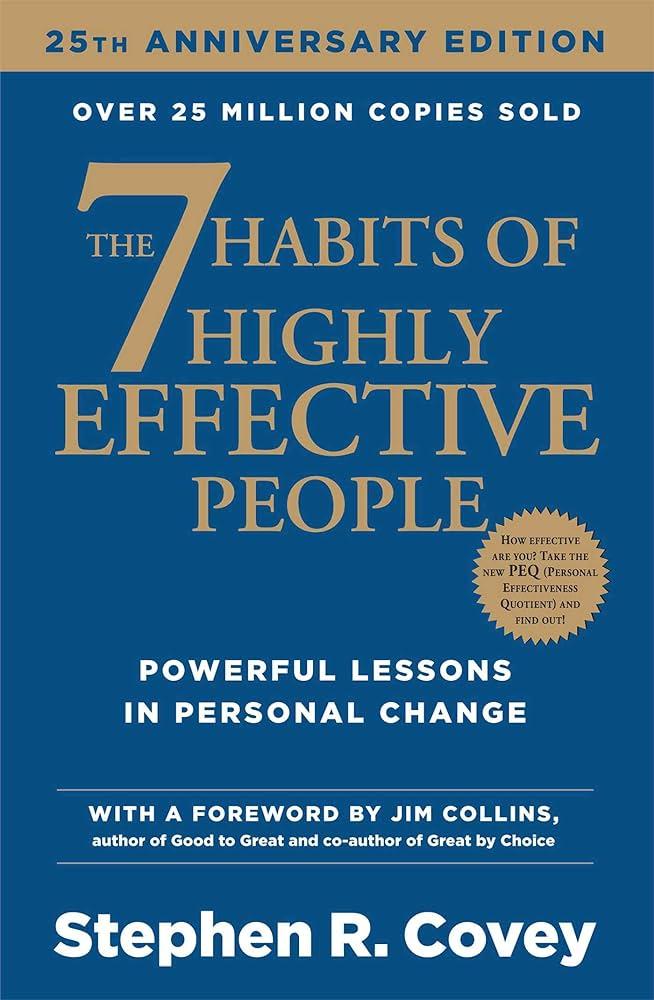
7 Habits Of Highly Effective People cover

7 Habits Of Highly Effective People

Stephen Covey
64 Quotes7 min readHabits
Buy on Amazon ↗
1

Winning is a habit. So is losing.

2

Knowledge is the quickest and safest path to any success in any area of our lives.

3

Fundamentals are the key to success.

4

Necessity is the mother of invention

5

Two people can see the same thing, disagree and yet both be right.

6

It becomes obvious that if we want to make relatively minor changes in our lives, we can perhaps appropriately focus on our attitudes and behaviors. But if we want to make significant, quantum change, we need to work on our basic paradigms.

7

In the words of Thoreau For every thousand hacking at the leaves of evil there is one striking at the root. We can only achieve quantum improvements in our lives as we quit hacking at the leaves of attitude and behavior and get to work on the root the paradigms from which our attitudes and behaviors flow.

8

Paradigm shift.

9

If you do not let a teacher know what level you are -- by asking a question, or revealing your ignorance -- you will not learn or grow.

10

Thoreau taught, "How can we remember our ignorance, which our growth requires, when we are using our knowledge all of the time?"

11

11 It says if you want to have a happy marriage be the kind of person who generates positive energy and sidesteps negative energy rather than empowering it. If you want to have a more pleasant cooperative teenager, be a more understanding, empathic, consistent, loving parent. If you want to have more freedom, more latitude in your job, be a more responsible, a more helpful, a more contributing employee. If you want to be trusted, be trustworthy. If you want the secondary greatness of recognized talent, focus first on primary greatness of character.

12

We are what we repeatedly do. Excellence, then, is not an act, but a habit. -- Aristotl

13

True independence of character empowers us to act rather than be acted upon. It frees us from our dependence on circumstances and other people and is a worthy, liberating goal.

14

Effectiveness lies in the balance -- what I call the P/PC Balance TM. P stands for production of desired results, the golden eggs. PC stands for production capability, the ability or asset that produces the golden eggs.

15

Anytime we think the problem is "out there," that thought is the problem.

16

The proactive approach is to change from the Inside-Out: to be different, and by being different, to effect positive change in what is out there -- I can be more resourceful, I can be more diligent, I can be more creative, I can be more cooperative.

17

The proactive approach to a mistake is to acknowledge it instantly, correct it, and learn from it

18

It is important to immediately admit and correct our mistakes so that they have no power over that next moment and we are empowered again.

19

Management is doing things right; leadership is doing the right things.

20

Management is efficiency in climbing the ladder of success; leadership determines whether the ladder is leaning against the right wall.

21

Real success is success with self. Its not in having things, but in having mastery, having victory over self.

22

There is little security, guidance, wisdom, or power in the limited center of self. Like the Dead Sea in Palestine, it accepts but never gives. It becomes stagnant.

23

No involvement, no commitment.

24

Effective management is putting first things first. While leadership decides what "first things are.

25

Organize and execute around priorities.

26

Quadrant II is the heart of effective personal management. It deals with things that are not urgent, but are important. It deals with things like building relationships, writing a personal mission statement, long-range planning, exercising, preventive maintenance, preparation -- all those things we know we need to do, but somehow seldom get around to doing, because they are not urgent.

27

when the urgent is good, the good can keep you from your best, keep you from your unique contributions, if you let it.

28

Again, you simply can not think efficiency with people. You think effectiveness with people and efficiency with things

29

Remember, frustration is a function of our expectations, and our expectations are often a reflection of the social mirror rather than our own values and priorities.

30

The late J. C. Penney was quoted as saying that the wisest decision he ever made was to "let go" after realizing that he could not do it all by himself any longer.

31

Effective management is delegation.

32

Point out the potential failure paths, what not to do, but do not tell them what to do.

33

33 Stewardship means a job with a trust. I trust you to do the job, to get it done.

34

There can be no friendship without confidence, and no confidence without integrity -- Samuel Johnson

35

Unless we are willing to achieve real independence, it is foolish to try to develop human-relations skills.

36

It takes character to be proactive, to focus on your Circle of Influence

37

In relationships, the little things are the big things

38

Unclear expectations will lead to misunderstanding, disappointment, and withdrawals of trust.

39

That is why it is so important whenever you come into a new situation to get all the expectations out on the table. People will begin to judge each other through those expectations.

40

One of the most important ways to manifest integrity is to be loyal to those who are not present.

41

It is more noble to give yourself completely to one individual than to labor diligently for the salvation of the masses.

42

When parents see their childrens problems as opportunities to build the relationship instead of as negative, burdensome irritations, it totally changes the nature of parent-child interactions.

43

And the habit of effective interpersonal leadership is Think Win-Win.

44

Anything less than win-win in an interdependent reality is a poor second best that will have impact in the long-term relationship

45

If you can not reach a true win-win, you are very often better off to go for no deal.

46

If a person can express his feelings and convictions with courage balanced with consideration for the feelings and convictions of another person, he is mature, particularly if the issue is very important to both parties.

47

Win-Win Agreements focus on results, releasing tremendous individual human potential and creating greater synergy, building PC in the process instead of focusing exclusively on P.

48

Seek First to Understand, Then to Be Understood. This principle is the key to effective interpersonal communication.

49

The amateur salesman sells products; the professional sells solutions to needs and problems.

50

Ethos, pathos, logos -- your character, and your relationships, and then the logic of your presentation .

51

You save tremendous amounts of time, energy, and money when you tap into the human resources of a business at every level.

52

Carl Rogers taught, "That which is most personal is most general.

53

"We seek not to imitate the masters, rather we seek what they sought," we seek not to imitate past creative synergistic experiences, rather we seek new ones around new and different and sometimes higher purposes.

54

Sameness is not oneness; uniformity is not unity. Unity, or oneness, is complementariness, not sameness. Sameness is uncreative...and boring. The essence of synergy is to value the differences.

55

Sometimes when I consider what tremendous consequences come from little things.... I am tempted to think...there are no little things. -- Bruce Barton.

56

Character cannot be made except by a steady, long continued process.

57

The late Dr. Hans Selye, in his monumental research on stress, basically says that a long, healthy, and happy life is the result of making contributions, of having meaningful projects that are personally exciting and contribute to and bless the lives of others.

58

Service is the rent we pay for the privilege of living on this earth.

59

Goethe taught, "Treat a man as he is and he will remain as he is. Treat a man as he can and should be and he will become as he can and should be."

60

Your economic security does not lie in your job; it lies in your own power to produce --to think, to learn, to create, to adapt. That is true financial independence. It is not having wealth; it is having the power to produce wealth.

61

He who wants to keep his garden tidy does not reserve a plot for weeds.

62

To keep progressing, we must learn, commit, and do -- learn, commit, and do -- and learn, commit, and do again.

63

he who cannot change the very fabric of his thought will never be able to change reality, and will never, therefore, make any progress.

64

Emerson: "That which we persist in doing becomes easier -- not that the nature of the task has changed, but our ability to do has increased.